
Sign Up. Stay Informed.
Our Plan
Louisiana's Coastal Master Plan
Following Hurricanes Katrina and Rita in 2005, the Louisiana Legislature created the CPRA and tasked it with coordinating the local, state, and federal efforts to achieve comprehensive coastal protection and restoration. To accomplish these goals, CPRA was charged with developing a master plan to guide our work toward a sustainable coast. Developed using the best available science and engineering, the master plan focuses our efforts and guides the actions needed to sustain our coastal ecosystem, safeguard coastal populations, and protect vital economic and cultural resources. To ensure we build on past success and take advantage of new science and innovation, the Louisiana Legislature requires the master plan to be updated every five years. It is a living document that changes as our understanding of the landscape improves and technical advances are made. We continually work to improve our methods to ensure projects are completed as efficiently and effectively as possible. Louisiana citizens will see this progress reflected in upcoming annual plans and in the future updates of the master plan. Use the menu on the left to browse our previous master plans, and the progress we are making in developing the 2029 Coastal Master Plan.MASTER PLAN GOALS, OBJECTIVES, AND PRINCIPLES
The master plan identifies robust projects that meet the two primary goals of the plan, to reduce [1] storm surge-based flood risk and [2] land loss across the coast both today and into the future. However, those are not the only concerns of coastal Louisiana residents and the master plan is developed with people in mind. To better meet the needs and values of Louisianans, these objectives and principles have been identified. Together, these goals, objectives, and principles reflect years of coastal planning experience and serve as guidelines for developing and implementing a comprehensive coastal master plan.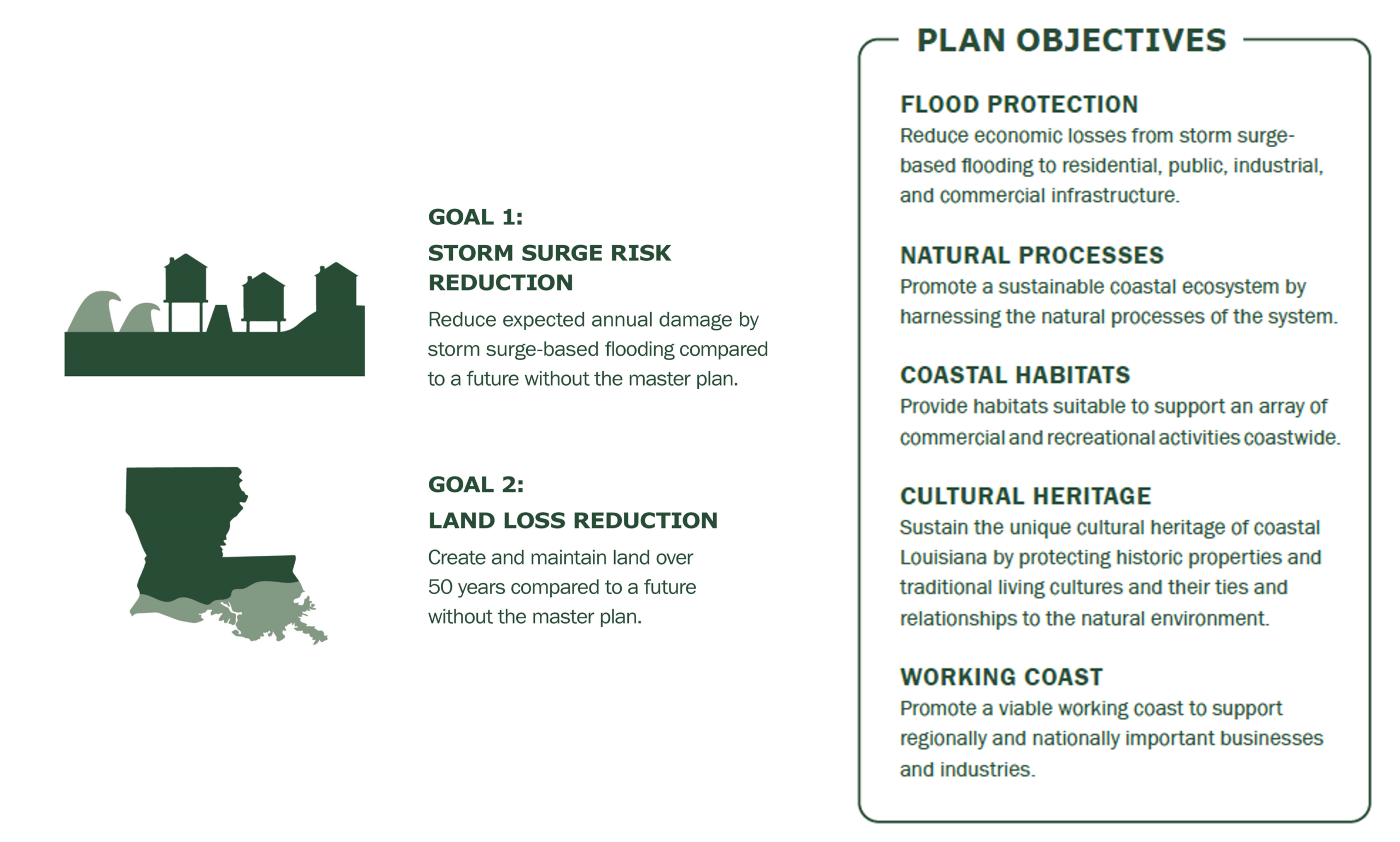
PRINCIPLES
Working Together- Collective Responsibility. The state, through the master plan and with its partners, develops the common vision for our coast. Achieving a sustainable coast, however, is a collective endeavor that requires input and feedback, and coordinated action from our state, federal, and local government partners, and various other interested and affected parties including non-governmental organizations (NGOs), business, industry, and academic and research institutions.
- Participatory Process. The master plan was developed with the participation of the many diverse interests that live, work, play, and own property in coastal Louisiana, along with national interests that have a stake in coastal Louisiana’s landscape.
- Regulatory Effects. Revisions to some laws and regulations may be needed to help the state’s coastal program better achieve its goals, and cooperation is needed from local, state, and federal partners.
- Role of Private Landowners, Business, and Industry. Close working relationships with private landowners are essential, not only for their support, but to gain knowledge about private coastal lands. Since Louisiana is also a working coast, partnerships with businesses and industries are also important for the success of the coastal program.
- Urgent Need to Take Action. In order to have the best future outcomes, we must plan, design, and implement projects now to address increasing land loss and storm surge-based flood risk in the future.
- Planning for the Future. The master plan is charged with providing a sustainable long-term solution for coastal protection and restoration.
- Providing for Transitions. Louisiana’s coastal crisis has and is displacing people, infrastructure, businesses, and entire communities. Sensitivity and fairness must be shown to those whose homes, lands, livelihoods, and ways of life may be affected by master plan projects or by continued land loss and flooding.
- Accounting for Uncertainties. Planning for the next 50 years means acknowledging a certain level of financial, environmental, and scientific uncertainty. We do know, however, that land loss and increased flood risk will continue, and the risk of doing nothing is far greater than the risk of acting with incomplete knowledge.
- Adapting to Changing Circumstances. The master plan is updated every six years with model and process improvements, including the integration of newly available data, to respond to changing economic, social, environmental, and climatic conditions in Louisiana’s dynamic coastal communities.
- A Systems Approach. The master plan was developed using a systems approach to risk reduction and restoration, whereby projects that are effective under a range of future conditions were selected.
- Clear Expectations. We cannot recreate the coast of the 20th century or even retain the coast of today. Instead, we must plan to help shape a new landscape that will continue to support viable natural and human communities into the future.
- Acknowledging Residual Risk. Risk reduction measures and restored coastal habitats cannot eliminate all storm surge-based flooding risks. Some degree of residual risk is inevitable.
- Efficient Use of Resources. The master plan was developed in a way that acknowledges the need for efficient use of resources, such as funding and sediment. The plan’s analysis seeks to capitalize on synergies among projects, resolve overlaps and conflicts, and promote sound management of resources.
- Sediment for Restoration. At present, limited supplies of, or access to, renewable sediment resources constrain the restoration efforts we can undertake. We consider both natural processes and dredging options to meet our needs.